







Private Label Teeth Whitening Strips Compliance and Certifications: A Global Buyer’s Guide
A practical guide to compliance planning for private label teeth whitening strips, including market requirements, product documentation, formula considerations, supplier checks, and buyer questions.

- Quick Answer
- What Compliance Means for Private Label Teeth Whitening Strips
- How Compliance Requirements Are Determined
- Core Compliance Documents: What Buyers Should Request
- Factory and Product Certifications: What They Prove and Exclude
- Regional Compliance Planning: Market-Specific Considerations
- Buyer Workflow: Checklist Before Sampling, Artwork Approval, and Production
- Common Compliance and Purchasing Mistakes
- What to Look for in a Reliable Private Label Teeth Whitening Strips Supplier
- Discuss Your Project Requirements
- Frequently Asked Questions
- References
Private label teeth whitening strips do not have one universal compliance certificate. Buyers must assess the formula, active ingredient, intended claims, product classification, packaging, labeling, and destination-market requirements as one connected decision. The relevant evidence may include a safety assessment or CPSR, MSDS or SDS, toxicological information, ingredient and concentration records, artwork review, and applicable factory or product certifications. A certificate list is only useful when each document matches the exact finished product, formula version, packaging, claims, and market.
Quick Answer
The correct approach to private label teeth whitening strips compliance and certifications is to follow a clear sequence: (1) confirm your destination market and intended claims, (2) select the active ingredient formula—hydrogen peroxide, sodium chlorite, or PAP—based on market requirements, (3) request product-specific documents matched to that exact formula and market, (4) verify certificate scope and validity, and (5) obtain local regulatory confirmation where classification or current legal requirements are uncertain.
Compliance documentation supports a responsible launch; it does not automatically replace the buyer's obligations as brand owner, importer, distributor, or responsible party.
What Compliance Means for Private Label Teeth Whitening Strips
Compliance Is a Product-and-Market Assessment
For whitening strips, compliance is the combined review of ingredients, active concentration, intended use, claims, product classification, safety evidence, packaging, labeling, and destination-market rules. A strip marketed only for cosmetic whitening may be reviewed differently from one promoted for sensitivity relief, remineralization, gum care, enamel repair, or another medical-style benefit.
The buyer should define the launch market and claim set before asking a supplier for a fixed document package. A document prepared for one formula or market may not support another. The broader private label teeth whitening strips planning process should begin with this product-and-market definition rather than with artwork or a certificate list.
Why One Certificate Is Not Enough
Certificates answer different questions. A safety assessment addresses the safety of a finished formulation within an applicable framework. An MSDS or SDS communicates hazard, handling, storage, and material information. A factory quality certificate describes manufacturing practices or management systems. A product certificate may relate to a specific product category, claim, or regulatory pathway.
None of these documents, viewed alone, proves that a particular strip can be sold in every country. Current concentration limits, classification rules, language requirements, claims restrictions, and responsible-party obligations must be confirmed for the intended market.
Factory-Level vs. Product-Level Documentation
Factory-level evidence applies to a facility or management system. Product-level evidence applies to the finished formula, packaging, intended use, and claims. A manufacturer may hold a valid quality-system certificate while a newly developed whitening strip still requires its own safety assessment, labeling review, or market-specific documentation.
When buyers verify supplier compliance documentation, they should ask for the certificate scope, covered facility, product category, issuing body, issue date, expiration date, and relationship to the quoted product.
How Compliance Requirements Are Determined
Formula and Active Ingredient
Hydrogen peroxide, sodium chlorite, and PAP create different compliance questions. Buyers should confirm the exact ingredient name, concentration, formulation version, intended wear instructions, and finished-product format. A wet strip, dry strip, dissolvable strip, or alcohol-free strip can also require different directions, warnings, storage controls, and packaging review.
Formula selection is therefore not only a performance decision. It determines which safety evidence and market questions must be answered. Buyers comparing options can use this PAP vs hydrogen peroxide private label whitening strips comparison to organize the technical discussion without assuming that one active ingredient follows the same pathway everywhere.
Intended Claims and Product Classification
"Whitening" is not equivalent to every oral-care claim. Statements about sensitivity, gum care, remineralization, enamel repair, caries, or treatment can expand the review beyond a basic cosmetic positioning. The claim wording, supporting evidence, consumer instructions, and product classification should be reviewed together.
Cosmetic, oral-care, and potential medical-device considerations must not be assigned by a supplier's marketing description alone. The buyer should confirm the applicable classification with a qualified regulatory adviser or the relevant market authority before approving claims.
Destination Market
The same strip can require different formulation, labeling, or documentation review in different markets. North American buyers may need to examine applicable FDA requirements, while European projects may prioritize non-peroxide choices and local safety documentation. Regional planning is critical because selecting a formula before selecting the market can create avoidable reformulation and artwork delays.
Packaging, Labeling, and Instructions
Compliance extends to the consumer-facing pack. Confirm ingredient nomenclature, active concentration, directions, wear time, warnings, storage, shelf-life, batch or lot information, responsible-party details, language requirements, and any required importer or distributor information. The final artwork must match the approved formula and instructions, not merely a sample or an earlier quotation.
Core Compliance Documents: What Buyers Should Request
Request documents against a written product description containing the exact product name, formula version, active ingredient, concentration, packaging format, intended use, claims, and destination market. This prevents a common failure: receiving technically genuine documents that do not apply to the product being ordered.
| Document Type | Primary Purpose | Does Not Prove | Buyer Action |
|---|---|---|---|
| CPSR or Safety Assessment | Evaluates finished product safety within an applicable regulatory framework | Market authorization; universal approval across all countries | Confirm it covers the exact finished formula, intended use, exposure conditions, packaging format, claims, and destination market. Raw-material assessments do not automatically cover finished products. |
| MSDS or SDS | Communicates hazard classification, handling, storage, emergency measures, and material safety information | Product approval; regulatory compliance; market authorization | Use for logistics, warehouse handling, and workplace procedures. Do not treat as complete product approval or proof of market authorization. |
| Toxicological Risk Assessment (TRA) | Assesses safety of ingredients and exposure assumptions for the finished formula | Compliance with all markets; approval for different concentrations or uses | Ask which ingredients and exposure assumptions were assessed, whether the active concentration is current, and whether the document corresponds to the product supplied for sampling and production. |
| Ingredient and Formula Documentation | Provides current ingredient list, nomenclature, active concentration, and formula revision history | Regulatory approval; market authorization | Request confirmation of whether documents cover the finished formula or only raw materials. Formula changes should trigger a documented review before the revised product is placed into production. |
| Product Specifications and Test Records | Identifies strip format, gel system, packaging configuration, storage conditions, shelf-life basis, and traceability method | Regulatory compliance; market approval | Ask which test or assessment records are available for the finished product. Do not assume that a sample's appearance or wear experience proves regulatory compliance. |
| Label and Packaging Review | Confirms artwork, carton, sachet, instructions, claims, warnings, batch coding, and language versions match approved formula | Regulatory approval; market authorization | Submit complete artwork for review before printing. Ensure consistency between artwork and approved formula documents. Use this how to start a private label teeth whitening strip brand resource to place documentation before artwork and production decisions. |
Factory and Product Certifications: What They Prove and Exclude
ISO 22716 and GMPC
ISO 22716 and Good Manufacturing Practice for Cosmetics (GMPC) relate to manufacturing practices, hygiene, documentation, quality procedures, and operational controls for cosmetic or personal-care production. They are valuable indicators of a facility's management framework, but they do not automatically approve every whitening strip formula or every destination-market claim.
When reviewing an ISO certificate, compare the legal entity, facility address, certification scope, covered product category, issuing body, and validity. Buyers should still request current certificates for the quoted project.
ISO 13485 and Medical-Device Context
ISO 13485 is associated with quality management for medical devices. It becomes relevant only when the product classification and applicable legislation require a medical-device quality framework. Holding or referencing ISO 13485 does not, by itself, classify a whitening strip as a medical device or establish that a medical-device pathway applies.
CE Marking
CE marking is not a universal quality mark for all consumer products. Its relevance depends on product classification and applicable European legislation. Buyers should ask which legislation is being applied, whether the product is within scope, who prepared the technical documentation, and whether the CE claim relates to the exact finished product.
HALAL and VEGAN Documentation
HALAL and VEGAN documentation supports specific formulation, sourcing, ingredient, or process claims. It does not replace safety assessment, labeling review, classification analysis, or market authorization. For a HALAL-related claim, buyers should confirm the status of alcohol-free or other relevant formulation requirements and ensure that the certificate covers the actual product and facility.
Social Responsibility and Quality-System Evidence
BSCI and SMETA 4P provide social-responsibility and ethical-trade evidence. They are not product safety approvals. Buyers supplying retailers should keep social-audit evidence separate from formula safety, product testing, and regulatory documentation so that each requirement can be tracked to the correct owner and document.
Regional Compliance Planning: Market-Specific Considerations
The following sections outline typical product planning signals for major markets. Buyers must obtain local regulatory confirmation for their specific destination and product positioning. These summaries are not legal advice and do not replace consultation with qualified regulatory advisers in each target market.
North America
North American projects typically prioritize hydrogen peroxide formulations at concentrations such as 3%, 6%, and 8%. According to the U.S. Food and Drug Administration (FDA) - Cosmetic Products Guidance & Regulation, cosmetic and oral-care obligations depend on the product's claims, ingredients, safety, and labeling context. Do not treat a supplier's reference to "FDA" as a universal approval statement; ask what the reference specifically covers. Buyers should confirm applicable requirements with local regulatory counsel before finalizing artwork.
Europe
European projects often assess non-peroxide options, sodium chlorite formulations, and PAP alternatives alongside local concentration, claims, safety, and labeling requirements. The buyer must confirm the relevant pathway for the specific country and product positioning rather than assuming that a document prepared for one European market covers all others. Regulatory requirements vary by EU member state and by the United Kingdom. Obtain country-specific confirmation before final artwork approval.
Australia
Australia may require buyers to compare sodium chlorite, PAP, and hydrogen peroxide options against the intended regulatory pathway. The correct choice depends on the formula, claims, concentration, consumer instructions, and local requirements. Obtain market-specific confirmation before final artwork.
Mainland China
Projects for Mainland China commonly review lower-concentration hydrogen peroxide (typically below 3%) and non-peroxide alternatives such as sodium chlorite and PAP. Buyers should confirm local requirements for ingredient presentation, claims, packaging language, and product classification rather than transferring documentation from another region. Engage local regulatory support to confirm current requirements.
Middle East
Alcohol-free strips may support market positioning for Muslim consumers, but an alcohol-free statement is not the same as HALAL certification. If HALAL claims are planned, confirm the relevant religious, ingredient, process, and certificate requirements for the intended market. Requirements vary by country.
Emerging and Cost-Sensitive Markets
Wet and dry strips may be considered for cost-sensitive market testing, but the lower entry cost of a format does not remove the need for accurate instructions, storage information, shelf-life details, claims review, and traceability. A small pilot should use the same compliance discipline as a larger launch because early artwork often becomes the template for later production.
Buyer Workflow: Checklist Before Sampling, Artwork Approval, and Production
Use the following sequence to create an approval trail that connects the commercial order to the compliance file. This workflow helps prevent mismatches between sample, bulk formula, packaging, and documentation.
Market and Formula Confirmation
- Confirm the destination market before choosing hydrogen peroxide, sodium chlorite, or PAP.
- Record the formula version, active ingredient, concentration, strip format, and intended wear instructions.
- Define permitted claims and identify high-risk medical-style claims requiring separate review.
- Ask whether the sample and proposed bulk formula are identical.
Claims and Labeling Review
- Review whitening, sensitivity, remineralization, gum-care, enamel, and treatment wording.
- Check directions, warnings, storage, wear time, rinsing instructions, and consumer restrictions.
- Confirm responsible-party details, batch or lot coding, shelf-life information, and language requirements.
- Obtain written approval before artwork is released for printing.
Documentation Request
- Request current safety assessment or CPSR-equivalent documentation where applicable.
- Request MSDS or SDS, toxicological assessment, ingredient information, specifications, and available finished-product records.
- Record each document's version, issue date, issuing organization, product scope, and market scope.
- Confirm whether each document covers the finished product rather than only raw materials.
Packaging and Traceability Verification
- Match sachet, carton, insert, and shipping-unit information to the approved formula and instructions.
- Confirm packaging compatibility with the strip, gel, storage conditions, and shelf-life information.
- Ask how batch coding connects finished goods to production records and retained documentation.
- Request samples to assess adhesion, residue, wear experience, and packaging compatibility. Remember that a sample is not regulatory approval.
Critical RFQ Questions for Suppliers
- Which documents apply to this exact formula, concentration, packaging format, claims, and destination market?
- What changes (formula revision, concentration, ingredient substitution, packaging, or claims) would require a new assessment or artwork review?
- Which certificates are factory-level, and which are product-level? What does each cover?
- What are the customization conditions, minimum order requirements, delivery terms, and buyer responsibilities?
- How do you connect sample formula to bulk production formula? What documentation proves they are identical?
Common Compliance and Purchasing Mistakes
Treating a Certificate List as Market Approval
A long list of logos does not establish market authorization. Ask what each document proves and what it excludes. A supplier that provides only a certificate list without product-specific documentation is not addressing your actual launch risk.
Using Documents for a Different Formula
A document for PAP cannot automatically support a hydrogen peroxide strip, and a document for one concentration cannot automatically support another. Match the formula revision and active concentration in writing before placing a production order.
Approving Claims Before Regulatory Review
Marketing teams sometimes approve "repairs enamel," "treats sensitivity," or similar wording before the product classification is reviewed. This creates artwork changes and claim risk. Review claims before packaging design is finalized.
Ignoring Product Classification
Classifying a product as cosmetic, oral-care, or medical-device-related based only on its name can lead to the wrong document package. Classification should follow intended use, claims, ingredients, and applicable legislation.
Assuming a Factory Certificate Covers Every Product
A factory certificate applies within its stated scope. It does not automatically validate every formula, facility, product category, or export market.
Failing to Confirm Document Currency
Expired certificates, obsolete formula versions, incomplete signatures, or incorrect legal entities weaken the approval trail. Keep the current issue date, expiration date, and product scope in the purchasing file.
Sample-to-Production Mismatch
A common risk occurs when the sample formula and concentration differ from the bulk production formula. Before production release, obtain written confirmation that sample and bulk formulas are identical. Ask the supplier to provide batch records or test certificates proving formula consistency.
Packaging Claims Changes After Approval
If packaging claims or instructions are modified after artwork approval, trigger a formal review before printing. Document all changes and obtain written approval from the supplier and your regulatory team.
Shared Labeling Across Multiple Markets
Using the same label for multiple destination markets can create compliance violations if concentration limits, language requirements, or claim restrictions differ. Maintain separate artwork files for each market and confirm each before production.
What to Look for in a Reliable Private Label Teeth Whitening Strips Supplier
Document Control and Traceability
The supplier should connect each document to the exact formula, packaging, claims, and destination market. Ask how formula changes, ingredient substitutions, or packaging changes trigger document and artwork review. A reliable supplier maintains version control and can provide a clear audit trail linking sample, bulk formula, documentation, and production batch records.
Formula and Packaging Support
Evaluate whether the supplier can discuss hydrogen peroxide, sodium chlorite, and PAP options without presenting one formula as universally suitable. The supplier should identify the information needed to review sachets, cartons, instructions, warnings, and storage conditions for each destination market.
Quality-System Evidence
Check current ISO 22716, GMPC, ISO 13485 where relevant, and social-responsibility documentation by scope. Verify that certifications are current, that the legal entity and facility match your quoted product, and that the scope covers your intended product category and destination market.
Market-Specific Communication
A dependable supplier should ask where the product will be sold, how it will be positioned, and which claims will appear on the pack. A supplier that answers only with a general certificate list is not addressing your actual launch risk.
Production and Fulfillment Terms
Confirm customization requirements, minimum order conditions, delivery terms, packaging responsibilities, and whether the supplier supports or excludes dropshipping and overseas warehousing. Based on documented information, Double White Medical Technology Development (Guangzhou) Co. LTD operates with a minimum order quantity of 1,000 boxes for customized packaging and formulation orders, supports DDP and DDU door-to-door delivery services, and does not operate overseas warehouses or support dropshipping. Buyers should verify these terms in writing during the quotation and order process.
Supplier Background and Certifications
Double White Medical Technology Development (Guangzhou) Co. LTD has been operating since 1999 and maintains a 30,000-square-meter Class 100,000 cleanroom facility with 300+ employees and eight fully automated production lines. The company holds factory-level certifications including ISO 22716, GMPC, FDA, ISO 13485, SMETA 4P, and BSCI, and provides product-level compliance support for CE, CPSR, MSDS, HALAL, VEGAN, and TRA documentation. Buyers should request current certificates, verify scope and validity, and confirm that all documentation applies to their specific product and destination market.
Discuss Your Project Requirements
Before requesting a quotation, prepare the destination markets, preferred active ingredient, intended claims, packaging format, language requirements, and documentation expectations. A supplier can help you review these inputs against available hydrogen peroxide, sodium chlorite, and PAP strip options and clarify which points require market-specific confirmation.
Discuss your whitening strip compliance and certification requirements
Frequently Asked Questions
References
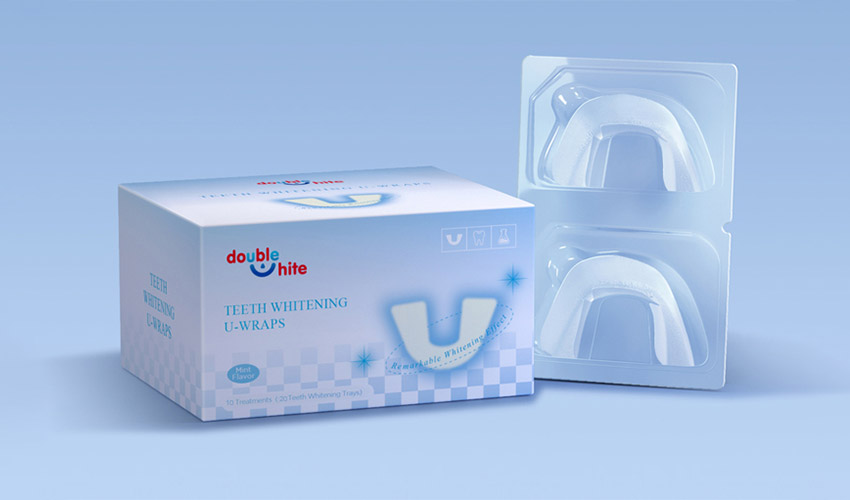
Purple Violet Teeth Whitening U-Wraps for Private Label & Wholesale

Purple Teeth Whitening U-Wraps: Private Label Sourcing Guide for Brands
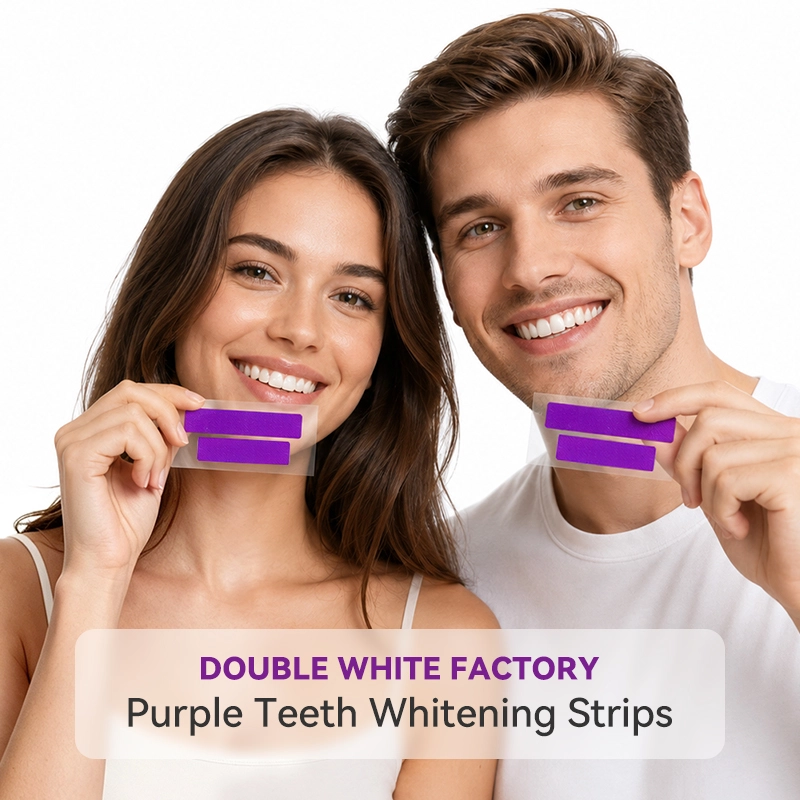
How Do Purple Teeth Whitening Strips Work? A Color-Correction Guide for Private Label Buyers

Whitening Pen Applicator & Dispensing Guide: What Buyers Should Check Before Bulk Production
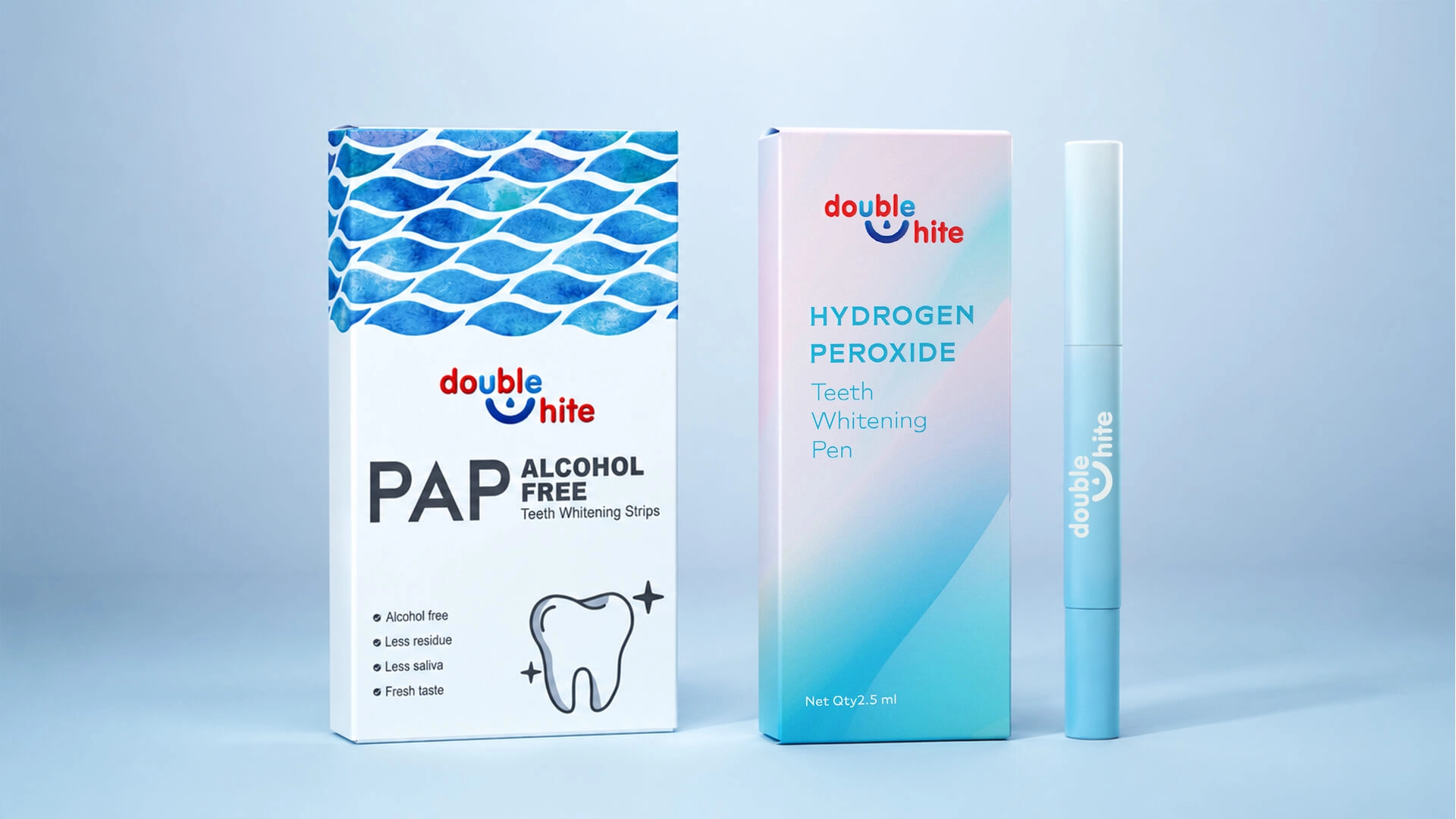
Whitening Pen Formula Stability: What Buyers Should Test Before Bulk Production
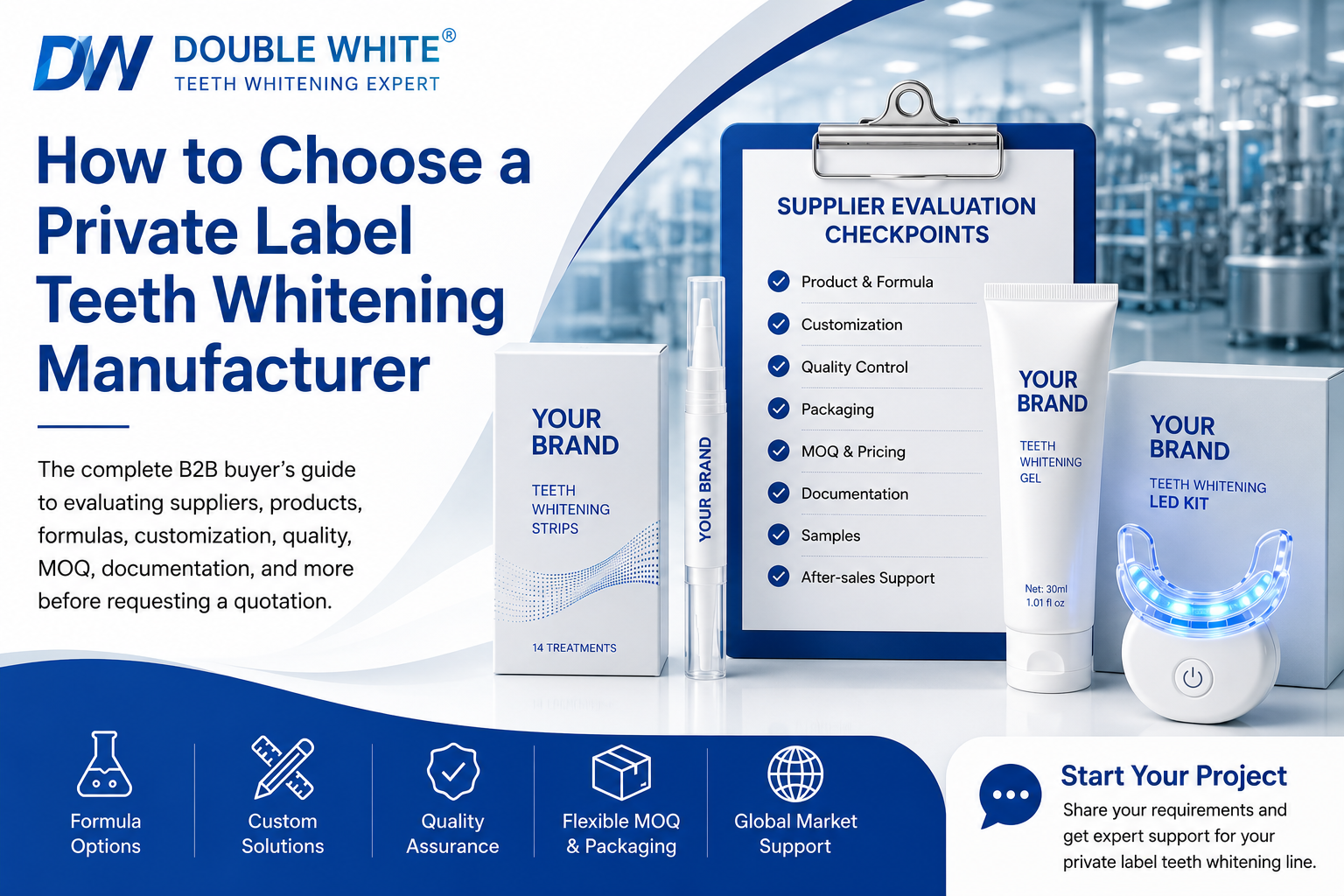
How to Choose a Private Label Teeth Whitening Manufacturer

Dissolving Teeth Whitening Strips
Double White Dissolving Teeth Whitening Strips offer an easy, mess-free way to brighten your smile. These strips dissolve quickly, delivering effective whitening results without residue. Perfect for daily use, they ensure a confident, radiant smile in minutes. Try Double White today!
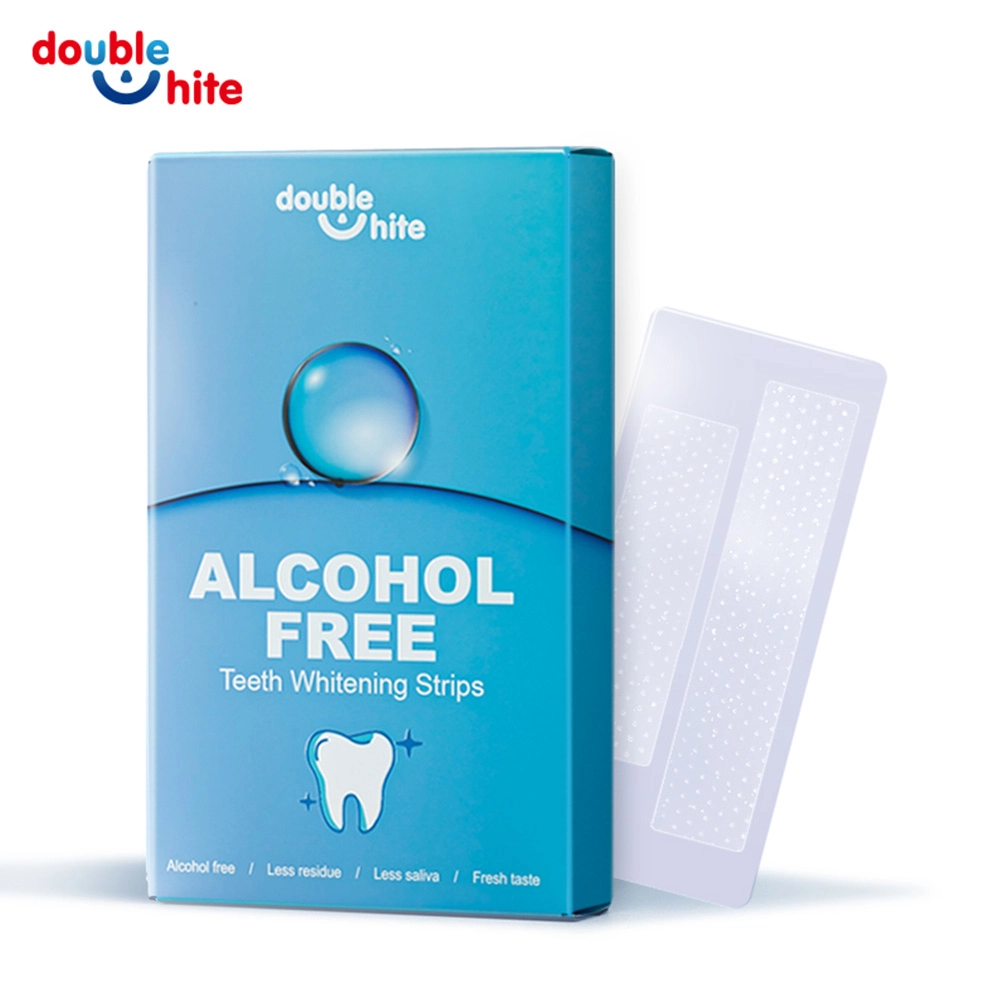
Sodium Chlorite Non-Alcohol Teeth Whitening Strips SCNA-01
SCNA-01 Sodium Chlorite Non-Alcohol Teeth Whitening Strips are designed for private label brands, wholesalers, salons, clinics, and e-commerce sellers seeking alcohol-free whitening strip solutions with flexible customization. This product uses sodium chlorite as the active ingredient and supports custom flavor, private label packaging, logo printing, sample development, and bulk production for different oral care markets.
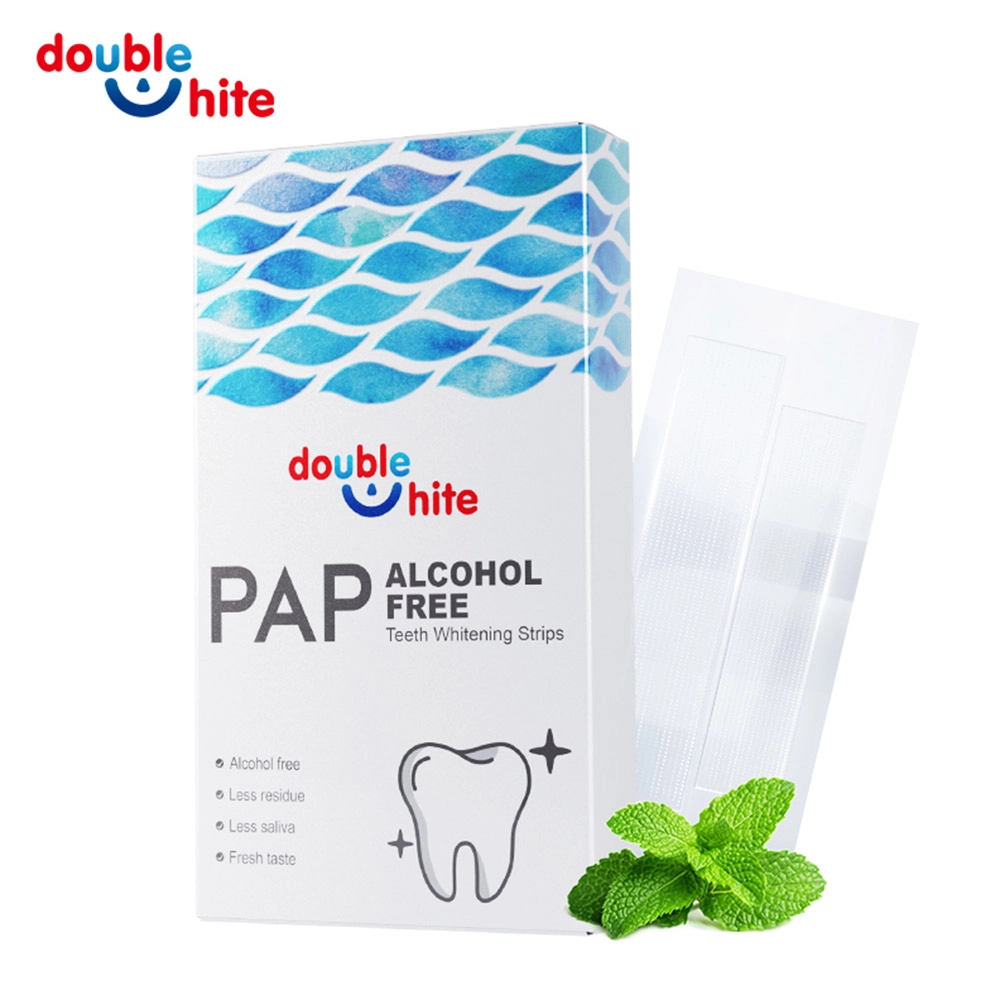
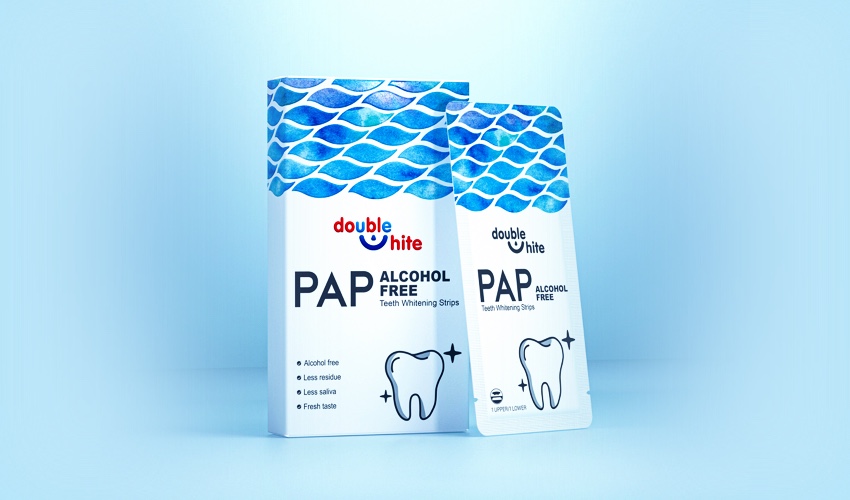
PAP Non-Alcohol teeth whitening strips OEM ODM PAPNA-01
PAPNA-01 PAP non-alcohol whitening strips for private label and wholesale projects. Review verified PAP formula, strip specification, packaging, treatment count, samples and relevant quality documentation. Sensitivity and performance claims require product-specific evidence.
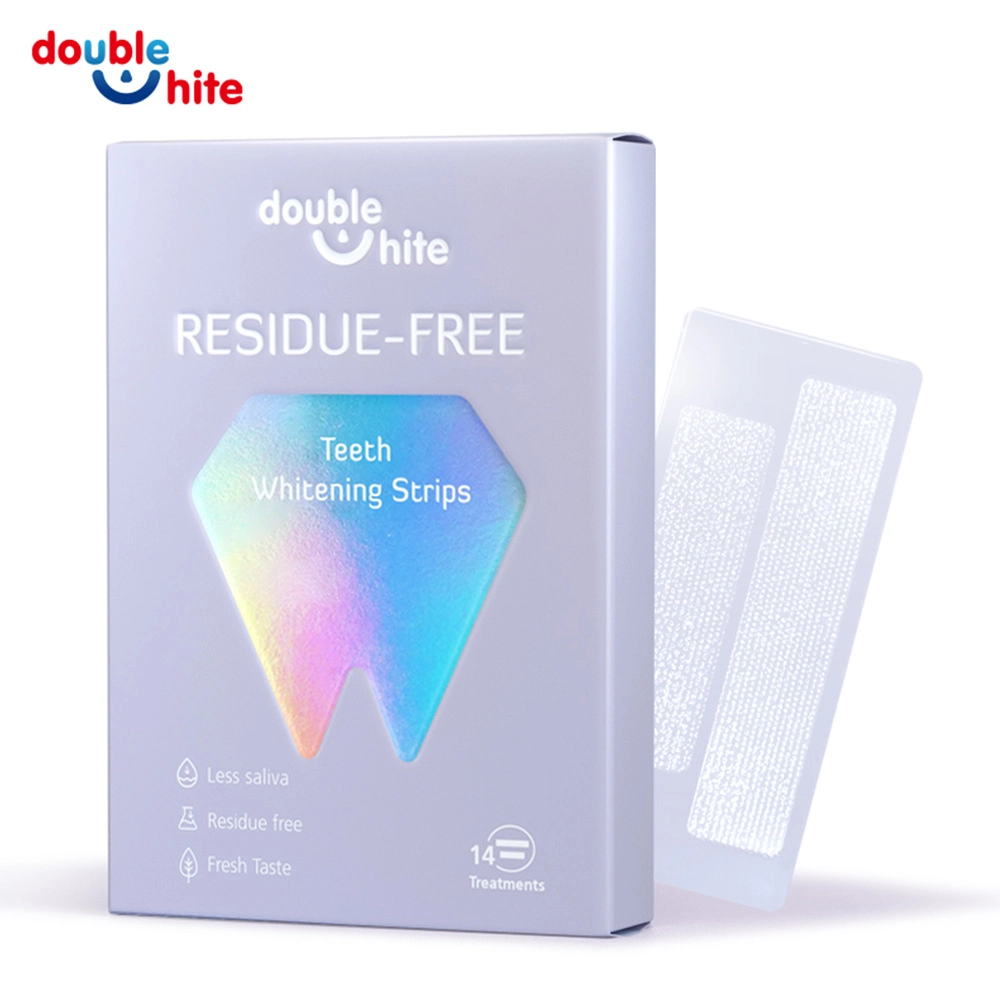
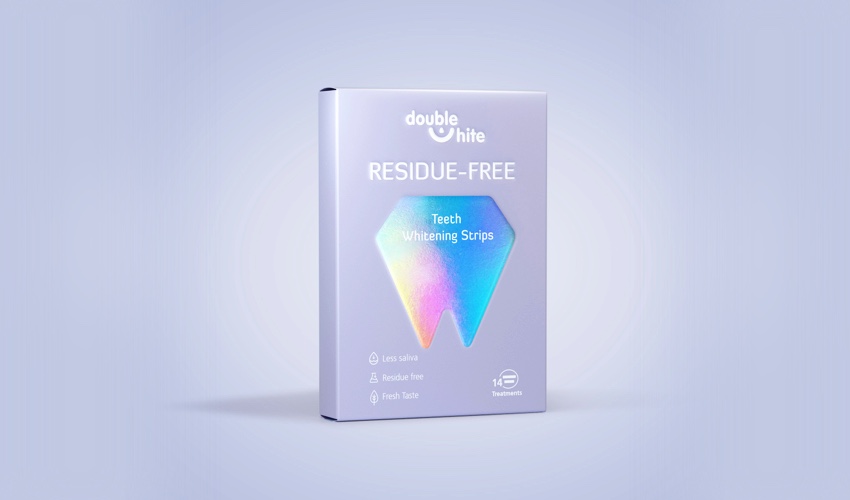
Hydrogen Peroxide Residue-Free Teeth Whitening Strips RFHP02
RFHP02 Hydrogen Peroxide Residue-Free Teeth Whitening Strips are designed for private label brands, wholesalers, salons, clinics, and e-commerce sellers looking for whitening strips with strong adhesion, clean removal, and a low-residue user experience. Double White supports custom flavor, private label packaging, logo printing, sample support, and bulk production for global oral care businesses.
Send us your inquiry
Reach out to us through the form below or via the contact information provided.
Our dedicated team is committed to providing prompt and personalized responses to all your queries.
Please fill out the fields above with your full name, email address, and comment.


Copyright © 2026 Double White All Rights Reserved. Designed by gooeyun
Whatsapp: +8615920313473
cndoublewhite
Doublewhite
doublewhite
cndoublewhite
cndoublewhite
Double White